Create Your First Project
Start adding your projects to your portfolio. Click on "Manage Projects" to get started


Wabinyo Sabinya
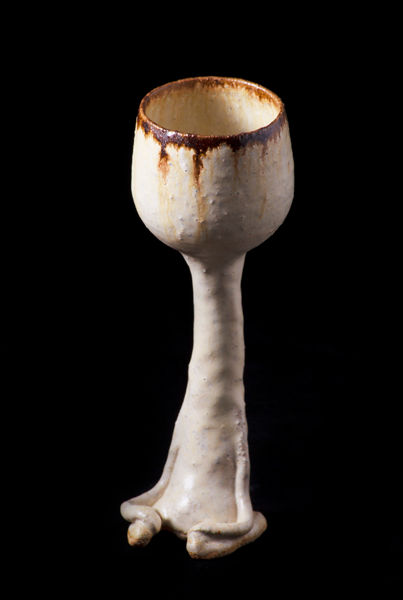
Wabinyo Sabinha is a series of ceramic clay works by the sculptor Akira Wakui.
The original experience that led to the idea for this work was watching Ultraman on television as a child. It is a scene in a tatami room in a small Japanese house, where an alien who has come to invade the earth and a human in his pre-transformation form as Ultraman are having a conversation in front of a low table.
This is very similar to the behavior and relationships of people in a tea room during the tea ceremony. The entrance to a tea room is small, and samurai cannot enter with a sword. Once inside the tea room, rules based on rank do not apply, and one must follow the rules of the tea ceremony, which are based on beauty. Anything that goes against beauty and does not follow them is uncool.
This scene from Ultraman, in which the invaders and protectors of the earth are sincerely talking to each other according to the rules of a small house,
later influenced the concept of Wakui Akira's work.
The origin of the word Wabinyo Sabinha series, which was created based on this concept, comes from the Japanese word "wabi-sabi."
In Spanish, when calling a child's name, adding "nyo" or "nya" to the end of the word gives a sound that evokes cuteness and affection, so Wakui Akira wanted a title that would convey the concept of "wabi-sabi," which may be difficult to understand at first glance, to children and people of different cultures.
The Wabiños and Sabinas came from outer space.
Their heads are teacups and vases,
which can actually be used in our daily lives by making matcha tea or putting sweets in them.
We have also held events where we used the works to imitate scenes from the tea ceremony and served tea to the audience.
In the ancient Japanese picture scroll "Night Parade of One Hundred Demons,"
demons with limbs that roam around on dishes and pots are depicted, and we speculate that this is largely due to the influence of an ancient Japanese belief that we can find souls or spirits in the tools that exist in our daily lives.
This is also called the "8 million faith," and can be translated into English as animism.
Animism is the idea that all things, whether living or inorganic, have souls or spirits. It is said to have been used in the late 19th century by British anthropologist Edward Burnett Tylor in his book "Primitive Cultures" (1871), and became a well-established term.
In Japan, only a very small number of people have the environment and customs to display large paintings and sculptures like in Western art culture, and the general sense and value is that so-called Western art culture and modern art are to be enjoyed in beautiful museums. However, we believe that the 8 million spirit still remains in cafes that utilize old houses and small cultures that bring healing. Wakui Akira continues to create his works imagining people who, in this modern lifestyle, would quietly stand there, smiling, looking at his works.